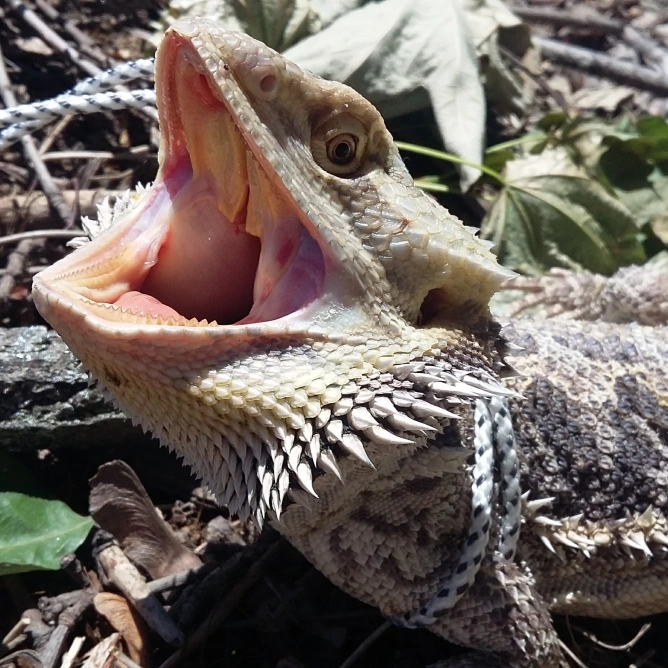
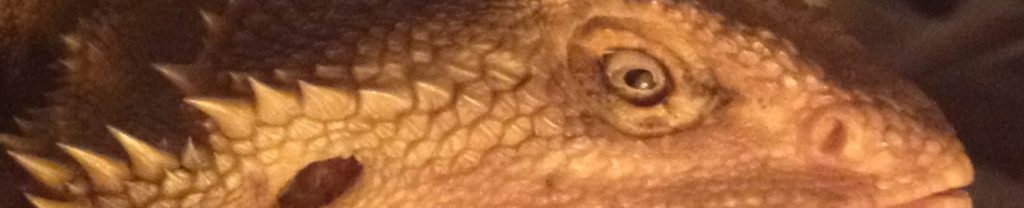
Instead, they absorb it when they have to.

Dry lizard skin keeps water out as well as in! The more we learn of these beings, the more amazing they are!!
“Using high-powered microscopes to examine the skin and scales of the lizards, researchers found that two species, the Australian horny devil and the Texas horned, have networks of tiny tube-like channels beneath their scales, which cover their entire body. These tubes funnel water across the body and into the corners of the lizard’s mouth, where it is then swallowed.”
*This site mentions an Australian horny devil. I believe the intention is Australian thorny devil.
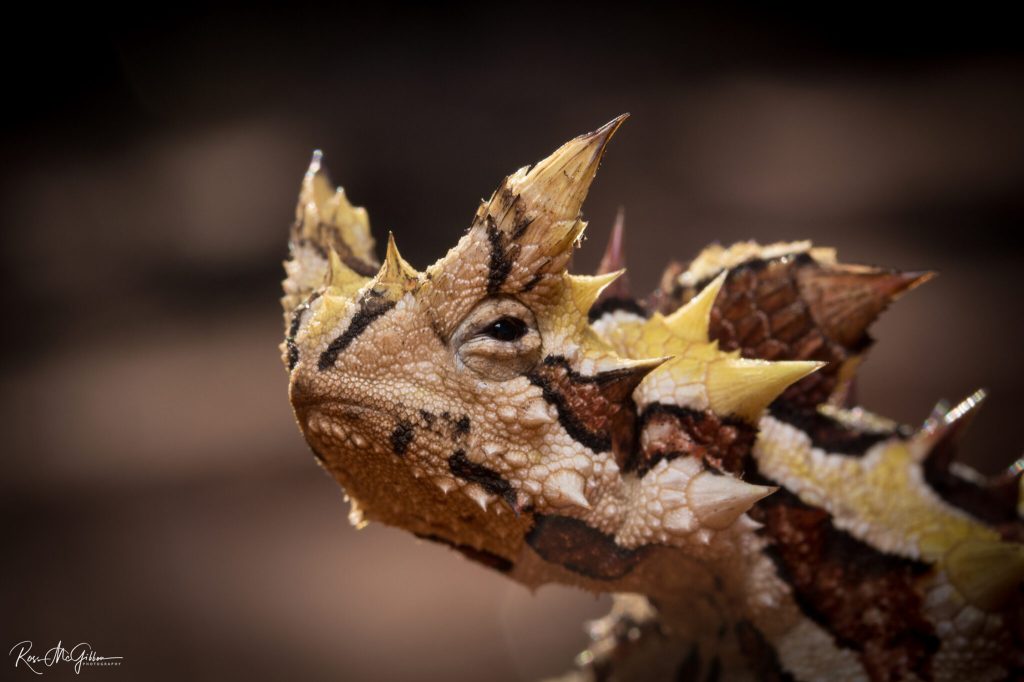
Photo by Ross McGibbon @ https://www.oriannesociety.org/photo-of-the-month/australian-thorny-devil/?v=400b9db48e62
Read about their awesome skin HERE.
With this, it’s important to note that statements as these, that arid or semi-arid land lizards and other reptiles don’t need extra water, or that they receive all the water they need through the moisture contained within the foods they eat can be misleading. Bearded dragons for example, found in arid to semiarid environments across eastern and central Australia, are in the category of reptiles that obtain the water they require from their diets, providing they have variety. However, if a beardie’s human parent is only offering insects and some leaves, they will become dehydrated.
Signs of dehydration include:
- Wrinkled and/or saggy skin
- Dented/cracked scales
- Trouble shedding
- Loss of skin elasticity
- Sunken eyes
- Yellow/orange urate
- Loss of appetite
- Lethargy
- Dull color
- Unusually aggressive behavior
- Weakness
- General “stress”
*The urate is the white part of a reptile’s poo. “In most reptiles, urine is produced as a semi-solid uric acid salt, known as urates, while mammals’ urine is produced in the liquid form of urea” *Dull color is difficult to determine as many lizards possess duller shades of greens and browns naturally.
Dehydration does the following (besides cause suffering – we know how it feels to be so thirsty):
- Decreases organ function
- Impairs skin health and the shedding process
- Decreases digestive motility
- Diminishes the body’s ability to remove metabolic wastes
- May affect assimilation of water-soluble vitamins
- Decreases appetite
- Decreases activity
Dehydration can also cause less pooing frequency and harder poo, which causes discomfort as your lizard tries to pass it. And, of course, ultimately, severe dehydration will lead to death.
There are a number of things to do to prevent dehydration in reptiles who do not live in moist environments naturally. Some lizard parents provide bog-type environments for their reptiles that require it. But, this should not be done for dry land reptiles. Too much moisture in the air can potentially cause those not biologically designed for it to develop respiratory infections and/or skin problems.
Instead, the cage can be misted with water occasionally. They can lap up water droplets they see moving if they know they need extra water. Despite good eyesight, some reptiles do not focus on still water. However, if a finger is wetted and dripped onto a lizard’s mouth, even a mildly dehydrated lizard will lick it eventually. If done over the water dish, they may lower their head and gulp water from it if they see the water source you’re using. Although desert reptiles may never drink from the dish you supply, it is best to keep one in their enclosure anyway and to wash and refill it every few days.
What is ideal, and should be done anyway to prevent dehydration as well as aid in shedding, is to soak reptiles (this goes for snakes, turtles, and lizards) in shallow (their vent and tail submerged, no chance of drowning), warm water (you can offer a soft chin prop to add to comfort) a few times a week for 20-30 minutes. This can be done in a cake pan, a sink, a storage tote, a tub, whatever. Just stay with them. Check the water temperature often. It chills quickly. Test the water’s temperature with your inner wrist and gauge this with the temp of your reptile’s skin at the time. Water that would be perfect for them may be a bit shocking if their skin is cooler that normal. Adjust as needed.
Another thing to do is to expand their diet to include more water-rich foods, just be sure to grow foods (pesticide, insecticide, and chemical-free) or make a grocery list based on what is safe for your particular reptile. Some lizards are finicky. If websites and books say that your lizard species likes blueberries or watermelons, that doesn’t mean yours will. So, be patient, if they’re extremely finicky, they may actually require (or demand) hand-feeding, and beyond that, even require being fed a special smoothie through a syringe! Lizards can be particular about some things, but they are so worth it.
Unfortunately, this level of care is not done for reptiles in pet stores that I know of. Many employees are just there to get a paycheck and are poor sources of advice. Those who genuinely care about animals have other responsibilities with the means of giving soaks and diet varieties deemed unnecessary for the living products by management. Many reptiles are in enclosures that are too small and dirty. These scaly beings (all the scaly animals, including fish, and especially the betta fish in cruel, tiny bowls) are bored and depressed. Yes, they have an emotional body, same as we do, to an equal or lesser degree. And yes, fish have some level of feelings too. I was taught this in a potent way, but, that’s a story for another time.
A final thing to mention in regard to adding moisture-rich foods to diets, because it is important and not common knowledge, is that fruits often have the most water content, but fruits also contain natural sugar, sugar that isn’t good for anyone’s teeth. Lizards that have acrodont teeth are prone to periodontal disease. These include, but aren’t limited to bearded dragons and Old-World chameleons. See if your reptile has acrodont teeth and know you may need to gently brush their teeth and gumlines after meals, and definitely after having some yummy fruit. This very gentle brushing may be accomplished with a puffed up cotton swab and vet recommended product such as Maxi/Guard or other antibacterial options he or she recommends.
🛒You can order Maxi/Guard here: https://amzn.to/3WwDYsN
See: How To Feed A Finicky Lizard for more tips.
“Reptilian scales are made of keratin, like hair, and found
in an overlapping arrangement. This creates a sort of environmental shield for the animal.
Snakes have special, elongated scales on their belly to help them crawl and climb. Some
reptiles have scales that are modified into sharp spines or have bony plates underneath their
scales, called osteoderms, for extra protection (like a turtle’s shell
and the bony back of an alligator). Reptile scales can also be found
in many colors to aid in camouflage or serve as warning to other
organisms of their venomous nature. Although most reptiles shed
their scales periodically, snakes shed their skin in a single piece.”
*Source: https://www.lsu.edu/mns/files/activities/Life-in-the-Bayou-1.pdf
Believe it or not, quite often lizards can feel tiny insects on much of their scales. One wouldn’t think so, but apparently and somehow, there are nerve endings or some sensitivity element right to the surface. This awareness of ants and other small creatures on a lizard’s scales have been witnessed by us time and time again, and on occasion, reactions indicative of experiencing a tickle! Reptiles also appreciate a soft item in their enclosure. They will lay on it or curl up into it. Our Lil’ Murph likes to have a tiny blanket cover him and his eyes right up to his little nostrils at bedtime. it makes him feel cozy and secure I suppose.

If you want to know more about those Texas horned lizards, also known as horny toads and Australian thorny lizards, tap the following: https://www.valleycentral.com/news/local-news/young-texas-horned-lizards-released-to-the-wild-in-ongoing-study
https://en.wikipedia.org/wiki/Horned_lizard
https://en.wikipedia.org/wiki/Thorny_devil
I want to share an example of a pet shop employee’s ignorance. Many years ago, my own ignorant self bought some species of semi-aquatic turtle as a gift for someone. I quickly got as much knowledge as I could from a reference book. In regard to tank design, the employee assured me that I simply needed to make certain the turtle could climb out of the water and bask when he chose to. What was unknown to all, was that if the water level around the basking spot is deeper than the turtle is wide (1/2 of that actually, if you consider where the nose is in relation to body width), the turtle can drown. And drown it did.

I cannot convey how terrible this is. The guilt still damns me when I think of little Chris, the Christmas gift turtle. He was such a sweety. Had I done more research and not taken one person’s advice, whom I expected to be some variant of an expert, Chris wouldn’t have suffered, nor would have the gift recipient.

Incidentally, In doing research today, I learned insect, reptile, and animal poop is called scat. Who else knew this? I wonder why people say, “Scat!!” to animals and insects as a means to get them to leave, and does that ever work? I’m not going to look into this now, nor probably not later. But, if someone wants to share the knowledge, we’ll be happy to learn of it.
*We earn a small commission from purchases made through links provided on this website as Amazon affiliates at no extra cost to you.

Do you dislike washing dishes? No matter how many are in your household, have each person use the same glass or cup for an entire day and designate a spot in the refrigerator or elsewhere for each person’s cup. If all that’s drank is water, the cup goes in it’s spot when empty. Other drinks can be rinsed out and the cup returned. This works for everything except creamy drinks such as milk and eggnog. There! Less cups to wash!
“Give me Lizardry or give me Death!”
❤️Murph & Dawn


Leave a comment