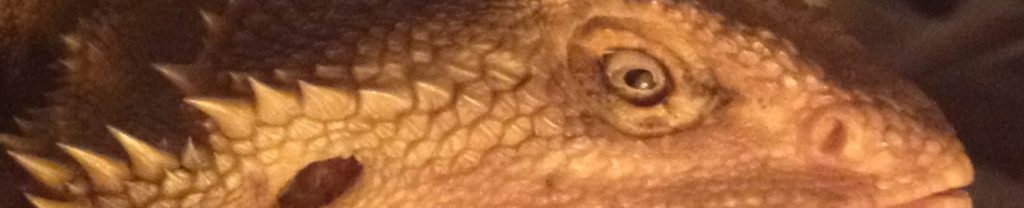
Although lizards may resemble cute, little dragons who’ve lost their wings, they don’t breathe fire and they don’t have dragon breath, but they do have amazing respiratory systems…
AND THEY DON’T ALL BREATHE THE SAME WAY!!
What do birds and lizards have in common besides scaly legs and eyelids that close from the bottom up?
Let me clarify on that above statement. The scales of bird legs are of the scute variety, while lizards have scales:
“Scutes are similar to scales and serve the same function. Unlike the scales of lizards and snakes, which are formed from the epidermis, scutes are formed in the lower vascular layer of the skin and the epidermal element is only the top surface…”
Source: Wikipedia
*Side note: There are different styles/shapes of scutes on bird legs, such as scutella, cancella, and reticula. And each serve their purpose. Birds share scutes with our other reptilian friends, the alligators, crocodiles, and turtles.
🦎READ ON TO LEARN MORE ABOUT BIRD AND LIZARD SIMILARITIES.🐦
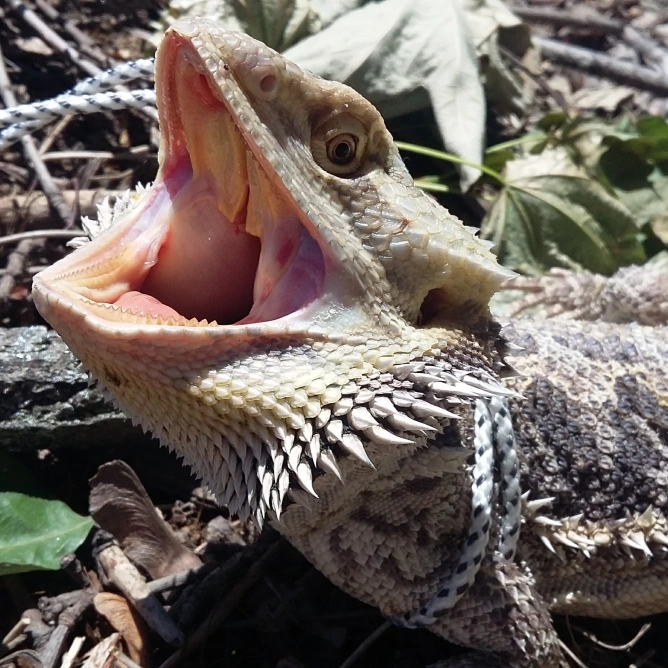
Let’s begin learning how lizards breathe with the lizard that looks most like a dragon to me, and that is the beautiful bearded dragon. I find their skull structures and spikes to exactly mimic the mental image I have of dragons.

🦎🦎🦎🦎🦎🦎🦎🦎🦎🦎🦎🦎🦎🦎

There are two known systems of respiratory air flow, they are unidirectional and tidal.
Tidal breathing is how humans and most mammals breathe (see image).
Bearded dragons have tidal breathing, as we do. This means they inhale and exhale through the same airways.
Although they possess bronchioles and bronchi, they don’t have alveoli (air sacs) per say, they have faveoli, which are their gas exchange structures. They’re similar to alveoli but are generally larger and arranged in a honeycomb pattern on the lung walls. They provide increased surface area for oxygen absorption for tiny lungs. This structure type uses muscle contractions and fluid pressure to facilitate respiration.
🦎🦎🦎🦎🦎🦎🦎🦎🦎🦎🦎🦎🦎🦎
Where oxygen goes once filling the alveoli or faveoli (air sacs), is through their thin linings and into surrounding blood vessels by the process of diffusion. Oxygen is getting transferred/diffused into the surrounding areas of less oxygen-rich areas. And, as the name suggests, the vessels transport the oxygen throughout the bloodstream to each cell. The body cleanses itself of carbon dioxide, and it leaves in the exact same way oxygen enters, except in reverse. Amazing!! It’s a system that works, and the majority of beings on our Earth breathe in this way.
The lack of a diaphragm prevents our lizard friends from breathing well and walking simultaneously, but there’s a solution to still get that needed air.
Lizards are very similar to us, and yet so different! They lack a true diaphragm. Intercostal and other chest muscles expand and contract their rib cages, changing the pressure inside their body cavities causing their lungs to inflate and deflate. As research suggests, the lack of a diaphragm prevents our lizard friends from breathing and walking simultaneously, forcing them to pause between movements to breathe. This means, that when lizards are being pursued by a predator, or a source of fear, and are running for their lives, they’re not breathing well. This is where gular pumping comes in to play. Lizards can do a rapid pumping with their throats to force air into their lungs! This is very similar to bruccal pumping of the mouth floor, used by amphibians and others. Monitors and agamids (including the Beardies) do this.
When lizards attempt to cross the smooth terrain of a hard, flat floor, we hear: Pitter patter slide, pitter patter [pause/breathe] slither slide, slide slide, [pause/breathe] slide! 😂It’s SO pitifully cute! I thought lizards mostly paused to ponder their next moves. Turns out, they may have been taking a breather in their relaxed atmosphere – literally!
A unidirectional breathing system, thought to be exclusive to birds to sustain the high oxygen demands of flight with a constant flow of fresh oxygen, has been discovered in the largest lizards of the world.
Say what?! Are lizards relative to birds? How much so? So interesting…
A unidirectional breathing system, thought to be exclusive to birds to sustain the high oxygen demands of flight with a constant flow of fresh oxygen, has been discovered in the largest lizards of the world, including crocodilians (alligators & crocodiles).
The lizards who possess unidirectional breathing are the magnificent monitor lizards and green and marine iguanas.

Research suggests around 80 recognized species
*Photo by Tom Fisk on Pexels.com
Why do some lizards have the same breathing mechanism as birds, but not others?!
I suppose it is to supply monitors the greater oxygen intake that they need to be the predatory animals they are, and these lizards are large, with the largest monitor lizard being the komodo dragon, growing to 10+ feet (3.48 meters) and weighing in at 365 lbs. (165.561 kg.)!
Those who follow with this breathing system are the next largest, being the other monitors (such as the Asian water monitors, nile, & savannah) as well as the green iguanas and marine iguanas. Now, green iguanas, like bearded dragons (beardies) become more herbivorous as they age, that they have unidirectional breathing was a bit mystifying to me until I read that the internet had this to state:
“Because unidirectional breathing is highly efficient at extracting oxygen, animals can achieve the required gas exchange with a lower overall volume of air moving through the lungs. Less ventilation means less frequent exposure of internal respiratory surfaces to the external environment, which in turn reduces the loss of heat and moisture (lower evaporative water loss).
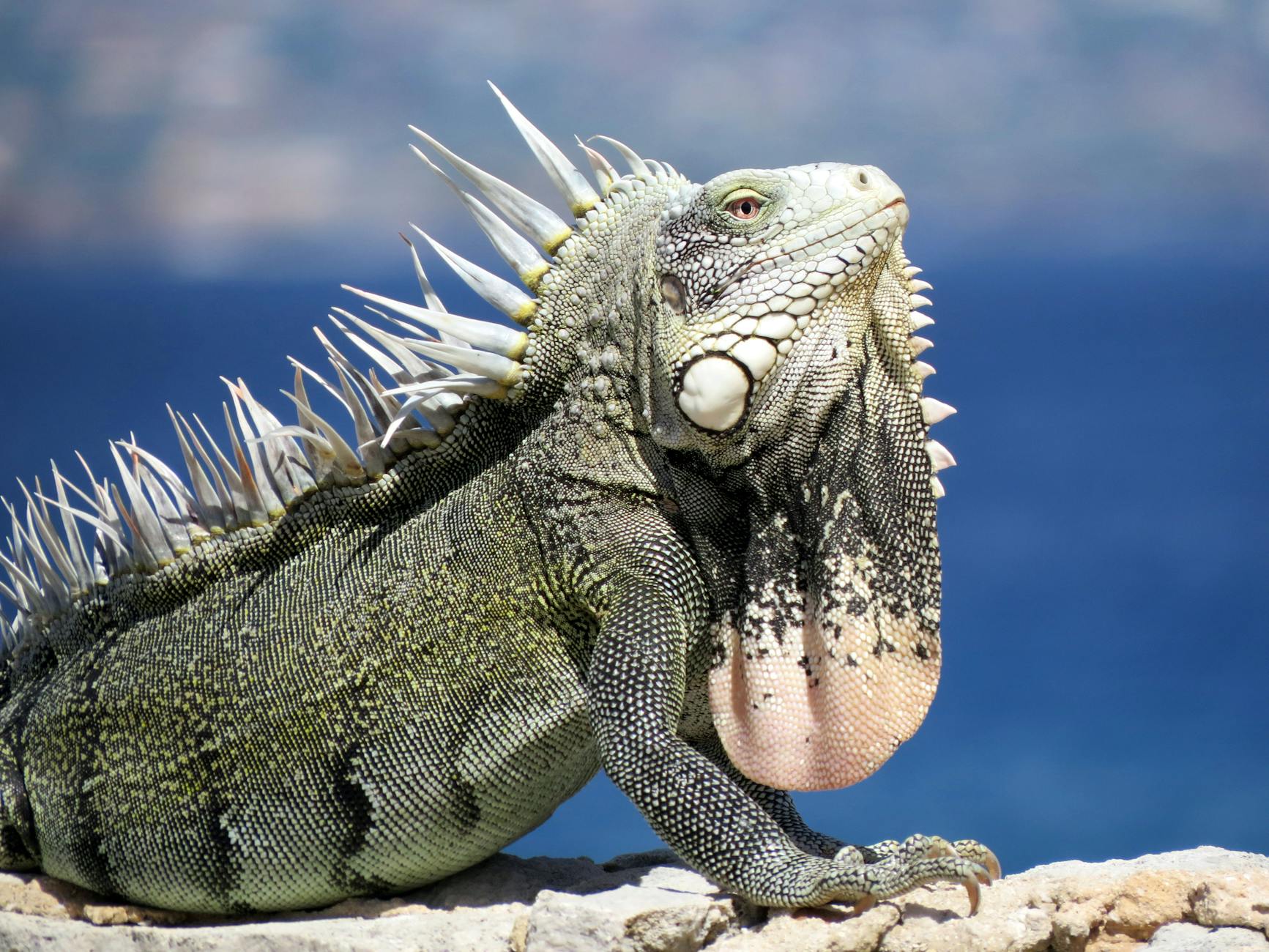
*Photo by ALVARO GUTIERREZ on Pexels.com
One way that unidirectional breathing helps the green iguana is by allowing it to hold its breath to minimize any motion to be very still when hiding from a predator, and even make an aquatic escape from its land predators such as large birds, snakes, dogs, etc., where they can hold their breath for up to 30 minutes, and possibly up to 4 hours if the water temperature slows their metabolism just enough.
Internet: A green iguana’s unidirectional breathing improves its ability to hold its breath by maximizing oxygen extraction and potentially using their heart as an auxiliary pump during apnea (breath-holding).
The image below features alligator lungs. Spot the arrows to give you an idea of a unidirectional airflow system found in large lizards and birds resulting in an awesome system of breathing to meet the demands of their bodies. Notice the carbon dioxide exit route through different chambers than the oxygen-intake route. Our tidal system has oxygen entering and carbon dioxide exiting through the same paths. This unidirectional breathing may have begun around 270 million years ago, or so states the internet and some beliefs on evolutionary history.

How did all the dinosaurs breathe?

I speculate that Pterosaurs, such as pterodactyls, had unidirectional breathing, what do you think?
Sources of information and interesting reads:
🦎https://phys.org/news/2013-12-mystery-lizard-one-way-airflow-million.html#google_vignette
🦎https://farmer.biology.utah.edu/Evolution%20of%20Uniflow.html
💎 https://pmc.ncbi.nlm.nih.gov/articles/PMC8694616/#:~:text=The%20lizard%20lung%20is%20faveolar,S1A).
💎
🦎 https://www.eurekalert.org/multimedia/917236

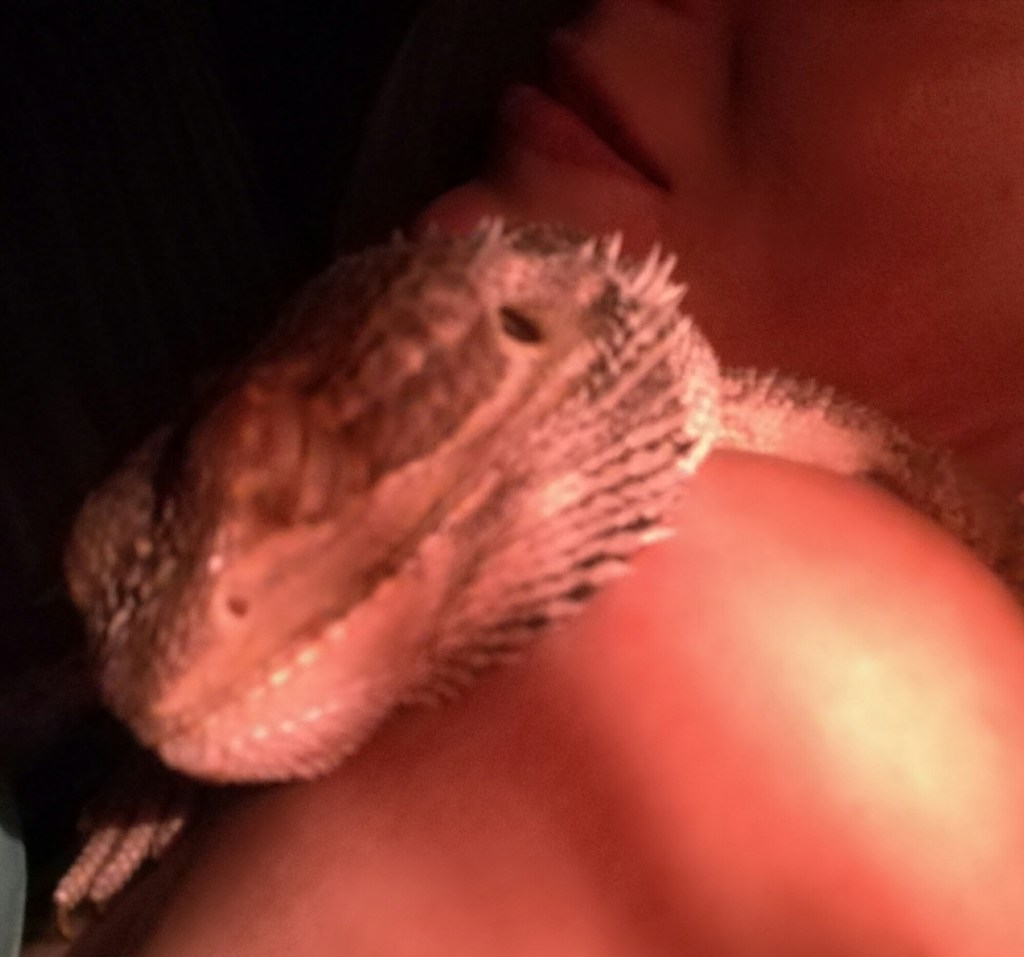
See that kissy position Lil’ Murph is in? People often comment on social media that lizards can’t breathe in this position. Yes, airways can be restricted to a degree in certain uncomfortable positions, but I assure you, if Murph can’t breathe, he’ll move! This is what living things do when they can’t breathe, they move to get air and survive. And another thing, under anesthesia, lizards are placed on their backs for certain surgical procedures. I do however, recommend people let there precious lizards be in positions in which they are most comfortable. Murph is more vertical here, and they do genuinely show displeasure when lying on their backs. This smooch lasted a second. If lizards are uncomfortable, they will let us know.
In this case, Lil’ Murph isn’t unhappy, he’s quite content. I separated him from our cuddle to kiss him. This is his cuddle position on me. He didn’t move when I pulled him away only to kiss him real quickly & capture his cute position, then return him to how we were both happy – cuddling. How adorable is this huge personality in cuddle pose?!
❤️🦎❤️
For those lizard lovers and Lil’ Murph fans, we have some new Murph merch and other lizard-themed gifts in our Meta•MURPH•osis collection, as well as new designs throughout The Dizzy Butterfly Emporium! Zazzle takes care of customer service and shipping worldwide.
As always, for all the Lil’ Murph fans out there, every design featuring Murph’s face or pretty scale images are knocked to the lowest royalty rate that Zazzle allows me!
MetaMURPHosis • To Honor Earth’s Beautiful Lizards
by TheDizzyButterflyEmporium
If you found this interesting or have anything you’d like to add for readers to see, please leave it in the comments.
“Give me Lizardry or give me Death!” – ❤️ Murph & Dawn


 LizardPlanet.com
Leave a comment